

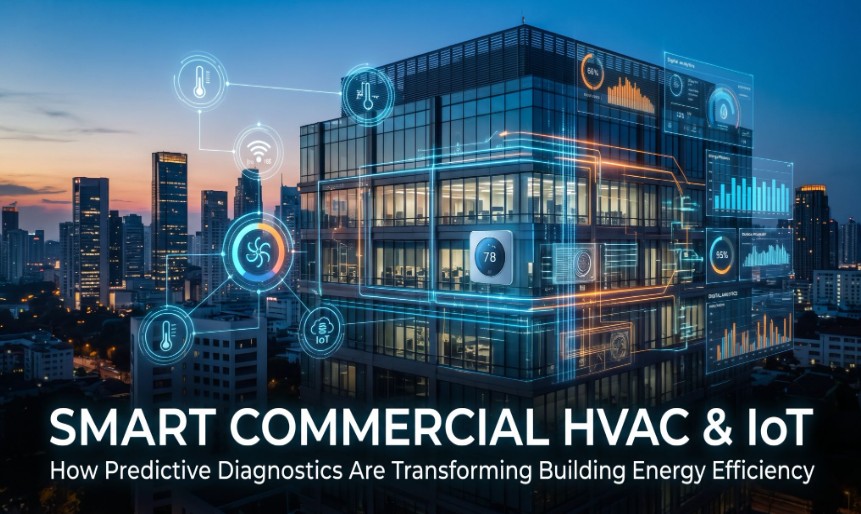
Commercial buildings account for nearly 40% of global energy consumption, and heating, ventilation, and air conditioning (HVAC) systems represent the single largest slice of that energy footprint. For decades, commercial climate control operated on a simple, reactive model: set a thermostat, run equipment on fixed schedules, and call a technician only when something breaks down.
Today, the convergence of the Internet of Things (IoT), edge computing, and artificial intelligence is fundamentally rewriting that playbook. Modern commercial HVAC is no longer just mechanical infrastructure—it is an intelligent, data-generating network capable of diagnosing its own inefficiencies before they escalate into costly failures or runaway utility bills.
The Hidden Cost of Reactive HVAC Maintenance
In traditional commercial facilities—from high-rise offices and data centers to retail hubs and healthcare complexes—HVAC degradation rarely happens overnight. Instead, efficiency erodes quietly through minor mechanical drifts: a slightly clogged air filter, a slipping blower belt, low refrigerant pressure, or a stuck economizer damper.
Without real-time visibility, these issues can go unnoticed for months. During that time:
Energy consumption spikes by 15% to 30% as compressors and fans work overtime to compensate for restricted airflow or thermal loss.
Equipment lifespan shortens due to continuous mechanical strain and frequent cycling.
Occupant comfort declines, leading to uneven temperature zones and poor indoor air quality (IAQ), which directly impacts workplace productivity.
By the time an alarm triggers or a zone loses cooling completely, facility managers are stuck paying for emergency repairs and unplanned downtime.
How IoT Sensors Create a Digital Nervous System
Predictive diagnostics start with granular data collection. Rather than relying on a single wall thermostat to govern an entire floor, smart commercial HVAC architectures deploy distributed networks of low-power IoT sensors across chillers, air handling units (AHUs), variable air volume (VAV) boxes, and ductwork.
These sensors continuously stream high-frequency telemetry on:
Supply and return air temperatures alongside relative humidity levels.
Differential air pressure across filters and coils to detect blockages early.
Electrical current draw and vibration signatures on motors, fans, and compressors.
Occupancy patterns and CO2 concentrations, enabling demand-controlled ventilation.
When aggregated through a Building Management System (BMS) or cloud-based analytics platform, this data forms a live digital twin of the building's thermal performance.
From Raw Telemetry to Predictive Diagnostics
Collecting sensor data is only half the equation; turning that data into actionable intelligence is where machine learning transforms building operations.
Predictive diagnostic platforms establish a dynamic baseline of how each piece of HVAC equipment performs under varying outdoor weather conditions and indoor occupancy loads. Using anomaly-detection algorithms, the software spots subtle deviations that human inspections would easily miss:
1. Early Fault Detection and Diagnostics (FDD)
If a compressor's amperage draw creeps upward while refrigerant subcooling drops, an FDD engine flags a potential refrigerant leak or fouling condenser coil weeks before a catastrophic shutdown occurs. Maintenance teams receive specific fault codes and root-cause probabilities rather than vague trouble tickets.
2. Eliminating Short Cycling and Thermal Drift
When commercial units repeatedly turn on and off in rapid succession—often due to oversized capacity, faulty sensors, or airflow restrictions—energy waste surges and components wear out prematurely. Proactively resolving issues like AC short cycling causes and fixes through automated diagnostics protects compressor longevity and stabilizes indoor temperatures.
3. Dynamic Load Optimization
Instead of heating or cooling empty conference rooms at full capacity, smart HVAC systems cross-reference occupancy sensors, weather forecasts, and utility time-of-use tariffs. The system can pre-cool a building during off-peak electricity hours and automatically throttle airflow in unoccupied zones without sacrificing thermal comfort.
Strategic Upgrades: Pairing Smart Controls with Modern Hardware
While retrofitting IoT sensors onto legacy equipment delivers immediate visibility, the highest return on investment comes when smart analytics are paired with high-efficiency mechanical hardware. Older fixed-speed compressors and outdated air handlers simply lack the modulation capabilities required to respond smoothly to granular digital commands.
When planning capital upgrades or new facility buildouts, modern commercial AC installation increasingly centers on variable-refrigerant-flow (VRF) systems, inverter-driven compressors, and smart damper actuators engineered for native BMS integration. Combining variable-speed hardware with predictive software allows buildings to match energy output precisely to real-time thermal demand—cutting overall HVAC energy use by up to 35%.
Implementation Roadmap for Facility Leaders
Transitioning from reactive maintenance to predictive HVAC management doesn't require ripping out an entire building's infrastructure overnight. Facility and operations leaders can phase in smart capabilities systematically:
Audit Critical Assets First: Prioritize chillers, rooftop units (RTUs), and primary air handlers where unplanned downtime carries the highest financial or operational penalty.
Ensure Open Protocol Compatibility: Choose IoT sensors and gateways that support open standards like BACnet, Modbus, or MQTT so data isn't locked inside proprietary vendor silos.
Establish Automated Alert Thresholds: Configure FDD dashboards to rank alerts by energy waste impact and equipment criticality, preventing alarm fatigue among maintenance staff.
Close the Loop with Preventive Workflows: Integrate diagnostic alerts directly into your Computerized Maintenance Management System (CMMS) so technicians arrive on-site with the exact replacement parts and diagnostic context needed.
The Future of Autonomous Buildings
As commercial real estate faces stricter ESG reporting standards, rising electricity costs, and ambitious net-zero targets, intelligent climate control has shifted from a luxury to a core operational necessity. By turning commercial HVAC systems into self-monitoring, predictive assets, businesses can simultaneously lower operating expenses, extend equipment lifecycles, and create healthier, more resilient workspaces.
Author Bio
Bradley S. is the owner of Oasis Air AZ, a Scottsdale-based HVAC company specializing in commercial climate control, energy-efficient cooling systems, and indoor air quality management.